Have you ever read an article or piece of information about a particular subject which offered you the thrill of thinking outside the initial topic covered, opening to you new analytic dimensions and making you reach conclusions that would impact your further professional choices?
 To me such a situation happened in July 2010, almost two years after assisting, same as many, to the compulsory “birth” of the “New Normal” that still affects our lives and professions today as well as for the years to come. I was trying at that time to find out how whole managerial and personal mindsets’ frames can change and adapt to “ignited” new realities.
Since 2009, relevant people were rightfully addressing the fact that we were guilty of educating many generations of decisional management layers in the “smooth sailing” attitude of preventing and avoiding “storms” rather than fighting with them (http://www.mckinsey.com/insights/risk_management/management_lessons_from_the_financial_crisis_a_conversation_with_lowell_bryan_and_richard_rumelt).
Coming back to July 2010, it was the time of the Football World Cup in South Africa. I like the game, no doubt about it. This is why I was reading the reports from the tournament with vivid interest. At one point in between quarter finals and semifinals, a particular article stroke me, an article that in itself became for me one of the most interesting articles about leadership I have read in many years. The article written by Dan Wetzel, a Massachusetts (US) born sports journalist, was called “Why soccer’s biggest stars failed to shine”.
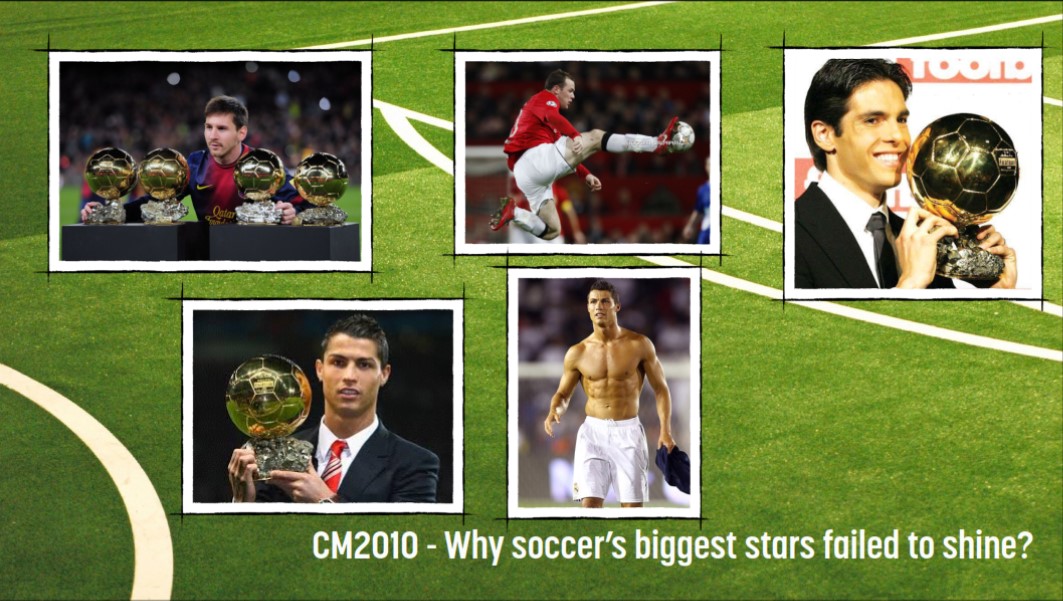 Now, I have to admit that I was a little bit prejudicial with respect to how football (soccer) was perceived and lived on the west side of Atlantic Ocean. So, puzzled by article’s title, I immersed into its content. Without spoiling the reading of it (just follow the next link to enjoy it yourselves http://sports.yahoo.com/news/why-soccers-biggest-stars-failed-163300892–spt.html), I would only say that the author made a very compelling argument based on a statement made by Diego Maradona (Argentina’s coach at 2010 World Cup): “Unlike the past, the stars weren’t selfish enough”. From this statement, the author tried to build up an analysis on why soccer’s superstar players (Lionel Messi, Cristiano Ronaldo, Kaka, Wayne Rooney) have not materialized the expectations put in them in that particular tournament.
Through the author is lately criticized for its argumentative straightforwardness (http://sports.yahoo.com/news/deal-with-it–south-korea–adelina-sotnikova-beat-yuna-kim-fair-and-square-152619212.html), back in 2010 he closed his argument in a “politically correct” manner, though pungent to some extent towards football fans: “…Maradona only knows the mentality that made him lead a country to World Cup glory. It certainly isn’t the only way. Perhaps it is one of them, though. And with most of the world’s top individual players home watching the semifinals … maybe … is true. Maybe they weren’t selfish enough. Maybe Maradona’s correct. Maybe the soccer world has gone soft.”
How this article made me review my old thinking dimensions and changed my future actions? This article came to me as an expected closing to that times’ public debates regarding the expected leadership reaction to the New Normal. And, following this article, I was stroked by a truth I tended myself to bury many times into a “sea” of political correctness. In a world in which we keep covering our actions in the “WE for US/THEM” envelope, we tend to forget about the person and its unique “selfish-positive-sparkling” engine that makes it wish being better every day.
It is the engine that helps most of us spending sometimes decades into education, numerous hours into an insane weekly working schedule and blasts our desire to outperform. It is the engine that is fueled with our courage to assume choices in life and career. And, how better one can describe the competitive present, other than as a succession of “Y-type” decision points we face in our day-to-day professional and personal life? The present that forces us at every level to assume choices, stand by them and take credit for their success or responsibility for their failures.
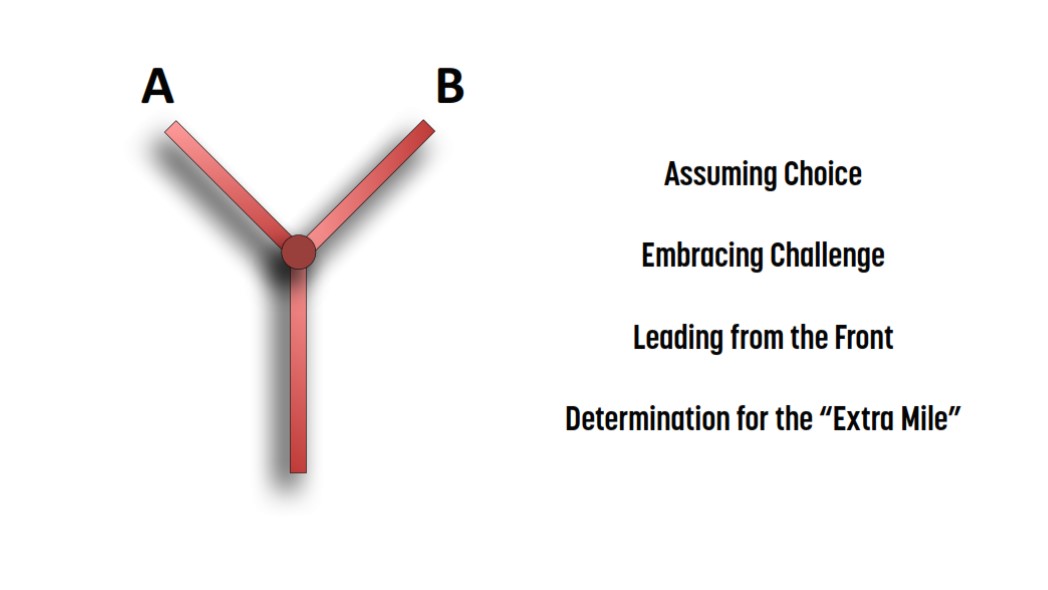 So, does the current leadership still belong only to hierarchical aspirational layers? I believe is far from the present truth. In my view, the new leadership should be about each of us being recognized for the courage of assuming choices in inflection points based on education and expertise, values we share as well as own (why not selfish grown) beliefs.
This is not a eulogy for the “WE for US/THEM”, as the reality still confirms us its success (let’s not forget that Spain and Netherlands fought in 2010 World Cup final, both having teams whose overall value was equalized among team players).
But for the time being as well as for near future, I believe that leadership of choice should be truly enacted and praised all the way through the hierarchical ladder. I believe that teams at every level should rediscover their star players, should praise their courage of assuming choices, many times ahead of others that are keen only to outclass the rest in “all-in-one-boat-consensus” chain emails.
 By stripping out leadership from the exclusiveness of established hierarchical levels we can offer a truly new mental dimensions to those “selfish-enough” to understand that battles are not always won by high numbers/high stakes but rather by the courage that inspire others to follow and support. Day to day, on simple things that interconnects themselves into a bigger picture.
In the end, I think all of us will benefit from such rediscovered/reemphasized people. We will be able to look to future more confident. Not that this will be easier nor successful proof. But if we would be able to predict leadership-by-choice’s success same as some would have been predicted, 28 years ago, the success one can reach just by taking the ball from his field and dragging his team all the way to goal and wining, then it worth being in the front line! Enjoy the view! http://www.youtube.com/watch?v=1wVho3I0NtU
 Hi Future! I'm first arrived? Perfect!
Discussion
No comments yet.