Lesson #1 – To win one should break “untouchable” model silos
Five years ago, on July 6th 2014, while playing against Costa Rica in the quarter-finals of 2014 FIFA world cup, Netherlands’ coach Van Gaal in a last minute stunning move decided to swap team’s goalkeepers just before the penalty shoots. He sent in reserve Tim Krul who saved two penalties sending the Netherlands onto the semi-finals. Some, considering penalties as a big mind game, were contemplating the bold move. They were arguing that Van Gaal succeeded to put doubt into the Costa Rica’s strikers now facing the reserve, enough to make two of them to miss their shoots, offering the Dutch a 4-3 victory on penalties.
 I, on the other hand, consider Van Gaal move as a needs’ based innovation of an existing game model that “accepts” goalkeepers to be changed during a game only if injured or playing extremely bad – none the case on July 6th nevertheless. Against old model’s acceptance, Krul’s introducing into the game was, in my view, an expertise-assumed response to an historical existing inflection point. Until that game Netherlands had 100% negative history track at world cup’s games every time it faced penalties. Van Gaal himself declared: “We found that among the keepers Tim Krul was the best at saving penalties because he has a longer reach and because we’d watched the Costa Rican penalties. So we studied their penalties and you can see that Krul picked the right corners.”
For the present business environment still blocked during last decades in “untouchable” pre-established model silos and benefiting only from cyclical “make-ups”, Van Gaal lesson can turn into a starting reflection point about how business’ future should look like. Already relevant opinion setters initiate discussions about radical changes that have to take place in the existing business models based on reemphasizing particular sets of expertise.
Ram Charan expressed such a view in Harvard Business Review’s July 2014 issue, in “It’s time to split HR”. He brought forward “radical but grounded in practicality” arguments for redefining HR model, particularly to eliminate the position of CHRO and split HR into two strands: HR-A (for administration – reporting to the CFO) and HR-LO (for leadership and organization – reporting to the CEO). Both strands would be led by people whose expertise should reflect the newly redesigned expectations for HR: “linking people and numbers to diagnose weaknesses and strengths in the organization, find the right fit between employees and jobs, and advise on the talent implications of the company’s strategy”.
In the same HBR issue, Bain & Company’s Aditya Joshi and Eduardo Giménez militate in their “Decision-Driven Marketing” that instead creating new silos by redrawing boxes and lines within own organizational charts as response to challenges, leaders should identify critical decisions and focus on improving the effectiveness of these decisions by injecting more discipline and expertise into their processes. According to Joshi and Giménez this approach requires a new mind-set for all the parties concerned and a shared commitment to rethinking how decisions are made and work is done.
Nonetheless, in considering this first lesson from the 2014 FIFA world cup, business should have in mind two other subsequent lessons:
Lesson #2 – if deciding to break model silos, make sure you keep relevant parts informed. When considering goalkeepers’ swap, Van Gaal left intentionally Cillessen out of the information loop as: “… we didn’t want him to know before the game”. As a consequence, Cillessen had a nervous outburst when changed though he apologized almost immediately after the game: “I can’t react in a way that puts myself above the team. We’ve got to do this together.”
During the last years, many businesses were forced to change their models in order to respond to external environment challenges. In doing so, some were keeping the design of the internal change process at a needs-base information level. By doing so, they succeeded to both frustrate and push away not only those that were directly affected but also the remaining ones, those that had the responsibility for succeeding further making the change worth something for the company.
I will argue that once you decide how your future would look like and with whom you will move towards it, in whatever business model combination, then you should not be afraid to share your plans. In my view, Cillessen lesson shows that once a person is transparently and objectively briefed upon an upcoming change, even if it is directly affected by it, then has no problem in understanding his role and contribution to the future overall success and being as well committed to it.
Lesson #3. – if deciding to break model silos, then stick to your proved-to-be-correct choices as long as same criteria are present. In Netherlands’ next game against Argentina in the semifinals, facing the most probably penalties closing, Van Gaal decided to use his last change in extra time by sending in a forward, rather than keeping once more the goalkeepers’ swap option active. He did that despite previously acknowledging that: “every keeper has specific qualities. Tim has a longer reach and a better track record with penalties than Cillessen” (Jasper Cillessen has never saved a penalty in his professional career and unfortunately kept his track record “immaculate” including in the match against Argentina when he was left to defend the gate up to penalties).
From pharma and health services to banking and financial services, companies are presently facing the challenge of changing their operating model either because of public scrutiny, tougher regulations or need for remaining profitable in an extremely competitive market. Unfortunately, many of them show no sign of exceeding the old-model’s “make-up” phase. It is somehow like their management, maybe due to its limited time tenure, remains stuck in a back-and-forth series of innovative trial/error experiments kept at small scale rather than showing boldness to leverage the successful ones at the corporate general level. Similar to Van Gaal, managers not leveraging upon bold-proved-correct choices, will only be remembered as good managers making at times eccentric experiments instead as someone innovating/changing the game.
Lesson #4 – Success is more memorable if it is achieved by just being correct rather than politically correct
2014 FIFA world cup will also be remembered by two particular matches: Netherlands vs. Spain (at the moment of the game acting world champion): 5-1 and the-one-and-only Germany vs. Brazil (host country and world cup winning candidate): 7-1. Both games were receiving open admiration but have also raised among aficionados of the game the question if a game should be stopped “politically correct” at let’s say 3-0 or 4-0, the level quantifying the stated obviousness of better value for one of the teams. Both games offered extreme images of joy as well as sadness, the last ones being maybe the cause for such comments.
 In spite of these views, the lesson that both winning teams offered us is the one of memorability related to the correctness of fighting for success beyond numbers. All teams enter any given tournament with the aim to win fair and square against their opponents. Their successes same as loses will be statistically counted.
Nevertheless, the engine that drives each sportsman and team in this respect is to commit until last minute of play to obtain in a correct way a memorable victory, independent of score’s dimensions, offering aspirational milestones of value that cross decades and generations. Most goals scored in a world cup’s match by both teams. Most goals scored in a world cup’s match by one team. Biggest margin of victory at the world cup. Ever. A throwing-towel “politically correct” choice would have taken all these away from our eyes and memories.
Present business environment is flooded with political correctness. In my view, many times valuable actions and achievements are denominated at team/organization’s level of corporate-guided political correctness, hence is taken out from them the deserved unique memorability. No matter how we would like ideally to portrait ourselves and our actions, we will never be the same in terms of expertise and achievements and some exceptional actions deserve to be praised more without being afraid of offsetting others’ accomplishments. I consider that by pushing and recognizing correctly achieved distinctive victories without edging their outcomes in a politically correct shell, we will be able to seed the high-achievement aspirational in mind of the others with business grasping all benefits that comes with it.
Lesson #5 – Politically correct packaged failures prevent us for grasping the true need for change
Subsequent to lesson #4, I believe that both Germany and Netherlands, by committing themselves to the win beyond a self/imposed political correctness, have offered as well a lesson to the defeated teams.
I consider that if both games would have been “stopped” due to political correctness at a particular score, neither Brazil nor Spain would have grasped the real need for change. By showing that the emperor is actually naked, Germany and Netherlands have forced their opponents to take bold measures of reconstruction, including resignations, changing of generations or even reviving a welcomed humbleness that sometimes disappears in the thin air brought by history and rankings.
Business people believe that by sandwiching the “constructive” feedback in a politically correct way, the beneficiary will better grasp the need-to-change message from the in-between politically correct slices. However, many times those offering the advice become disappointed when the consequences are not as expected. Maybe is time to look at lesson #5 and redesign feedback in a direct, transparent yet correct way.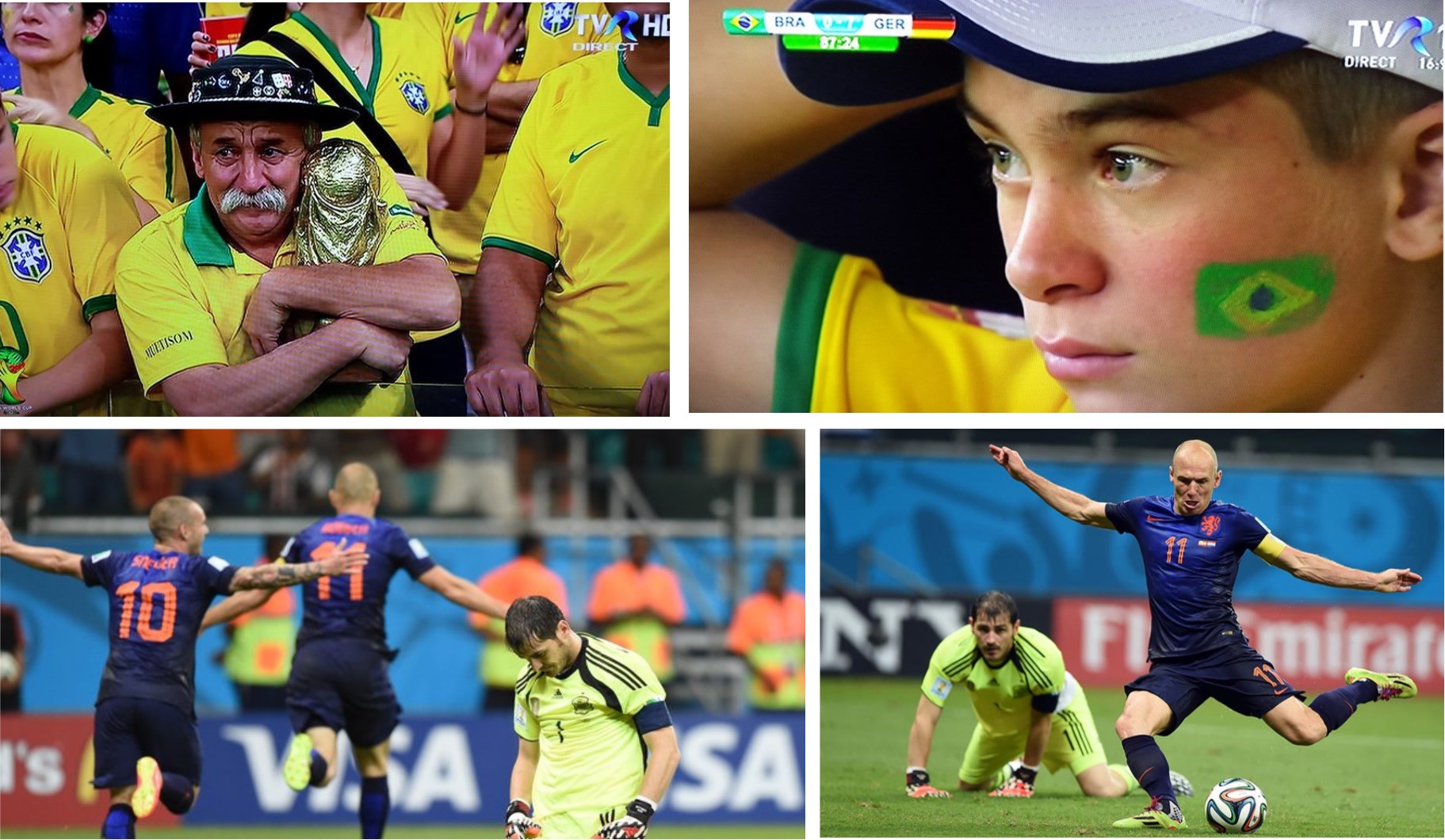
 Hi Future! I'm first arrived? Perfect!
Discussion
No comments yet.