Hi Future! I'm first arrived? Perfect!
It is maybe in human nature to wish to reach a zone we are comfortable with (socially, economically or just simply personally). The natural tendency for the many is to try to remain in that zone once they’ve reached it. Few are fighting to push further the barriers while even fewer are actually changing the game.
Many of us are seeing their wishful zone as a comfortable one, in a routine way. We tend to believe that a zone in which we continue doing repetitive things will help us live better, knowing that as the number of repetitive actions increase, our way of doing them will improve while in parallel we reduce our efforts associated with them as well. This works up until a particular place on the professional and social ladder, but after passing the aspiring hierarchical “entry point” does it function as well?
It is expected for people that serve “aspiring” positions to become examples for others, to push further the boundaries for dragging or inspiring the rest of us to convert ourselves to the better and to reach a contextualized wellness. For some, pushing boundaries or reinventing the game comes naturally as they are either believers, innovators or, why not, “adrenaline junkies”. But for many this should come as a result of hard work and readiness to change.
Here comes the problem for some of the good people I met during my business career years. Once they’ve reached the aspiring positions they deserved, in time they stop changing and choose a routinized approach. I still try to these days figure it why.
I know for sure that is not necessarily because these people want to have an easier life. They actually continue to work many, many hours per week. It might be because of the fact that some see themselves as experts and, once they’ve reached the highest position in their field of activity, they are blind in options other than continuing to do whatever they do, better and better in a repetitive way. It might be also because companies are actually striping out these people from any incentive they might need to get out from the standardized routine that organizations need to reach an overall efficiency.
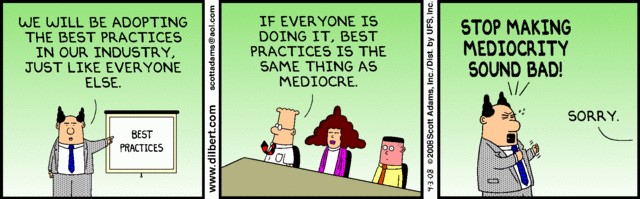 Or worse, even if none of the above, it might be a “logical fracture” between the ways we want to act and how we actually end up doing it. Just as an example, I am still surprised that in situations where is required to be “different” in order to be noticed and to remain on a condensed and competitive market, people in “aspiring” positions have the tendency to decide on applying “best practices”.
In my view, best practices while good in themselves, are historically belonging to past rather than present and are also publicly available to others, thus most probably used by the competition as well. Applying best practices just in themselves, without their contextualization in relation with own core differentiating points, is actually counterproductive. It will keep their user under the risk of still being kicked out from the market by those benefiting from bigger resource buffers or market dominance.
I want to point out that in none of the above situations is about the intrinsic value of people, because it is not the case. Nevertheless, at one point organizations tend to react to existing pressures by “refreshing” teams. Now the problem is not that those changed are not good but rather that is believed, at a strategically level, that others might do better in the same situation. It is also the fault of those being replaced for consenting, through lack of reinventing, to the commoditization of their “professional matrix” (intrinsic professional and personal values, boldness of actions and capacity to make others believe and follow), allowing comparisons where age and wage become influential factors.
 For me, the conclusion is straightforward. In my view, people that are presently in aspiring positions have to reinvent themselves by moving out from their present comfort zone and pushing further the containment boundaries in order to reach new levels of attractiveness in the eyes of the companies or markets. It is also about their professional survival as well, as it is clear for me that only a unique “professional matrix” offering the predictability of further exceptional outcomes will keep its owner hype and wished by the organizations or his followers.
Reinventing for either surviving or further excelling should be also a commitment one has to himself/herself and the historical efforts put into becoming the professional he/she is today as well as an obligation towards those that stayed by his/her side and supported him/her during the journey to success.
 Hi Future! I'm first arrived? Perfect!
Discussion
No comments yet.